
Anti-dystopia ⊗ Our horizon of possibilities
No.402 — AI learns language from skewed sources ⊗ We can always do something about the future ⊗ The hidden Sungemite archipelago ⊗ Where Europe’s population is shrinking ⊗ Rogue One: The Andor Cut
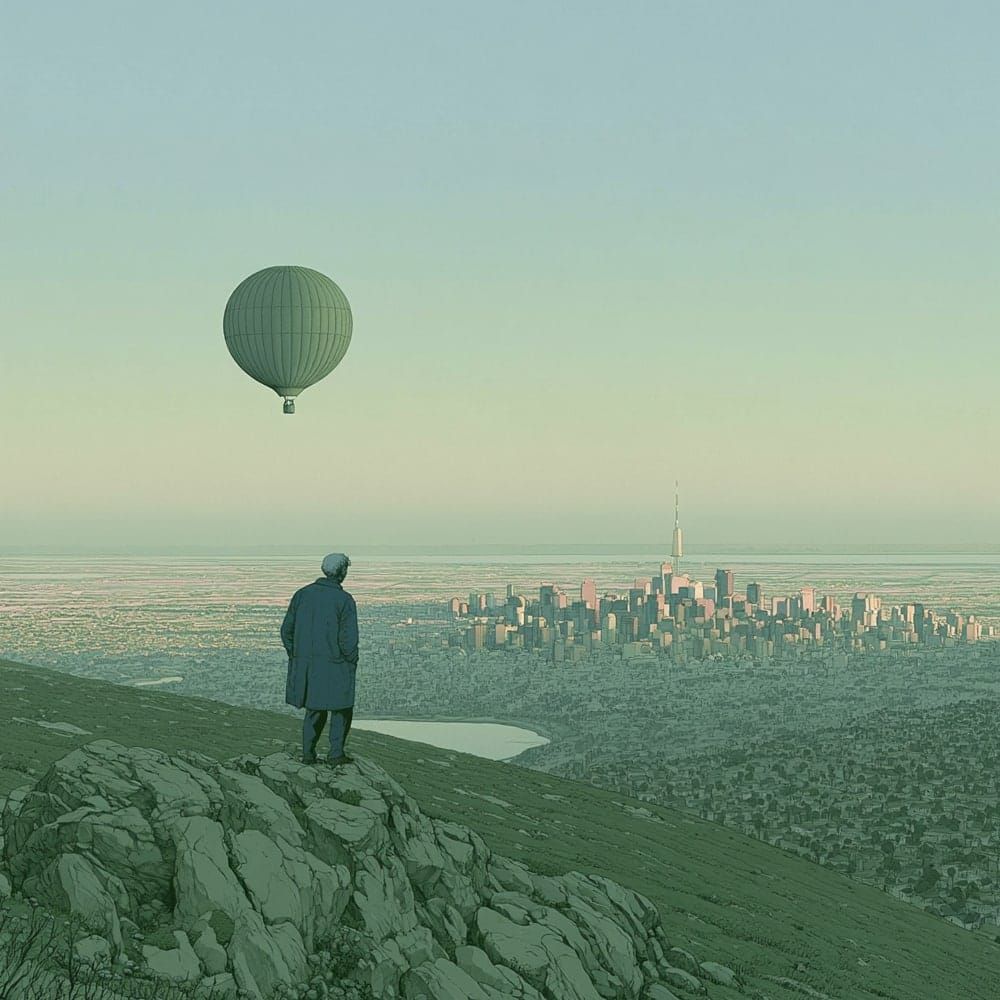
Anti-dystopia
Johannes Kleske, a futurist, strategist and friend of the newsletter, opens this piece by refusing both optimism and pessimism, because both positions treat the future as already decided. The same logic applies to utopias and dystopias. Invented as tools for action, we’ve converted them into forecasts. The dystopian version is currently winning, which is a problem, since the more people treat collapse as inevitable, the more they withdraw from the systems that could prevent it. Utopia on the other hand, “now means ‘disconnected from reality.’ Hard to build a movement on a word that makes people roll their eyes.”
The alternative he proposes is something the German political scientist Isabella Hermann, has named “anti-dystopia.” Her 2025 book Zukunft ohne Angst defines it through three characteristics: it starts inside the Anthropocene rather than imagining it away; it breaks the link between catastrophe and resignation by insisting that collapse is not the only possible outcome; and it refuses any endpoint or blueprint, treating contradictions as inherent to the process. Hermann even argues that enduring those contradictions is itself anti-dystopian. Octavia Butler’s formulation is fitting here: there isn’t one answer, there are thousands, and you can be one of them. Kim Stanley Robinson’s edit of MLK also makes the point directly: “the arc of history is long, but we can bend it toward justice.”
It’s notable that Kleske mentions KSR and The Ministry of the Future a few times, and it reminded me of one text in my notebook on the Imaginaries of AI, The Diversity of “Topia”, where I mentioned Dystopias Now, by the very same Robinson, where he presented a Greimas square consisting of four positions: utopia (the political order could be better), dystopia (it could get worse), anti-utopia (the project of imagining better is itself dangerous), and anti-anti-utopia, which rejects that pessimism. KSR’s argument in that piece is that we must occupy that fourth corner: defending the legitimacy of utopian imagination against those who call it naive or dangerous.
Beyond the words used, and just like Johannes refuses them, Robinson writes that “maybe we should just give up entirely on optimism or pessimism—we have to do this work no matter how we feel about it.”
Every utopia carries a shadow. Who is allowed to define the ideal society? What happens to those who disagree? Utopias tend to be exclusive (who belongs?), elitist (who decides?), and in their worst forms, totalitarian (what about dissenters?). One person’s utopia is, quite literally, another person’s dystopia. […]
It decouples catastrophe from resignation. This is the crucial move. Just because things are bad does not mean they must end in oppression or collapse. The values of justice, community, and transformation break the seemingly inevitable link between crisis and surrender. Catastrophe does not have to mean dystopia. That link is a choice, not a law of nature. […]
“Rebelling against the circumstances is always worthwhile. Because working for justice, community, and transformation, whether through small everyday actions or through the struggle for comprehensive social reform, is always better than doing nothing. And nobody needs to be afraid of doing the wrong thing, because anti-dystopian action is by definition an ongoing, contradictory process that has no perfect endpoint and offers no blueprint for ‘correct’ action.”
Our horizon of possibilities: how algorithms contract our world
Somehow I’d never heard about Hana Lee Goldin’s newsletter. I Iove the framing; “at the intersection of AI fluency and information literacy, explored through a librarian lens.” In this piece she draws on Husserl’s phenomenology to name something we all experience but rarely examine: our horizon of possibilities, the boundary of what we can perceive and therefore imagine. We can’t pursue a career we’ve never heard of, read a book we don’t know exists, or encounter a community that never reaches us. Algorithmic systems now shape this boundary. These systems are optimised for engagement and pattern-matching; they create what feels like abundance while the underlying diversity narrows. Scroll through hundreds of recommendations and they share the same basic similarities, offer the same perspectives in different formats. The filter can’t distinguish between content we don’t want and content we’ve simply never encountered; it removes both.
The consequences show up in many domains of our lives: recruiting algorithms that match keywords rather than transfer skills; dating apps that amplify existing preferences rather than introduce difference; news feeds that diverge by algorithmic profile until two people watching the same political debate read markedly different coverage. But Goldin resists making this “contraction” only a problem. A narrowed horizon helps with low-stakes, high-cognitive-load decisions—filtering dinner recipes, choosing a film. Sometimes fewer options enable choice rather than constraining it. The same mechanism that limits us in consequential decisions serves us in trivial ones.
The distinction she makes is between the contraction that happens by choice, for a specific purpose, and the one that operates uniformly and invisibly across all contexts simultaneously. The same optimization logic filtering dinner recipes is also filtering career opportunities, news sources, and relationship prospects. Without awareness that this is happening, we can’t evaluate whether it serves us or look elsewhere when it doesn’t. It’s this awareness that separates helpful curation from invisible constraint. And of course, people are funnelled into algorithmic views, and it gets harder and harder to see the whole landscape of possibilities, to jump beyond their boundaries.
Sometimes we benefit from systems that predict what we want and filter accordingly. Sometimes we need systems that show us what exists regardless of what we’ve chosen before. Sometimes we want efficiency. Sometimes we need discovery. Sometimes we’re looking for confirmation. Sometimes we’re looking for challenge. […]
When describing feeling overwhelmed, the AI might suggest “drowning in work” or “swamped with tasks” because those phrases appear frequently in training data. A comparison to a bird navigating through fog that would capture a specific experience surfaces less readily. We lose the sentences only we would write. […]
The algorithmic approach becomes limiting when we notice we’re stuck in a loop, when we suspect we’re missing something, when the same patterns keep appearing, or when we’re making a decision that matters and want to see beyond our usual information bubble. […]
Information literacy for the algorithmic age requires a different set of questions. Beyond asking “Is this source credible?” we need to ask “What sources am I not seeing?” Every search interface, every recommendation system, every feed shows us some things and hides others. Our information environment is curated; that curation serves specific interests. We can make choices about how much influence we give it.
§ AI learns language from skewed sources. That could change how we humans speak – and think. Written by two favourites I wouldn’t have expected on the same byline, Ada Palmer and Bruce Schneier. “Next, in the same way autocomplete has increased how much we use the 1,000 most common words in our vocabulary, talking with chatbots and reading AI-generated text may further constrict our speech. A recent University of Coruña study found that machine-generated language has a narrower range of sentence length, averaging 12-20 words, and a narrower vocabulary than human speech. Machine-generated text reads as smooth and polished, but it loses the meanders, interruptions and leaps of logic that communicate emotion.”
“Ambitious, thoughtful, constructive, and dissimilar to most others.
I get a lot of value from Sentiers.”
If this resonates, please consider becoming a supporting member—it keeps this work independent.
Futures, Fictions & Fabulations
- We can always do something about the future, by Monika Bielskyte. “The future is not a force of nature. It is a design project – and that means someone is always setting the brief. What are its unquestioned assumptions?”
- “My novel drops today. Read chapter one”. Looking forward to ADH’s new book! “ABSENCE is a book about cosmic mysteries, disaster bureaucracies, and never knowing what to believe”
Algorithms, Automations & Augmentations
- The hidden Sungemite archipelago. Another gorgeous genAI project by Pascal Wicht. “This project began with a simple proposition: that a generative image model, given a coherent enough ontological frame, will produce evidence of a world it has never seen but somehow already contains. The prompts were research questions. The images that came back were field documents from a civilization assembled out of latent sediment in the training data: centuries of East Asian material culture, medical illustration, cartographic tradition, craft epistemology, recombined into something that has never existed but carries the weight of things that have.”
- The global cybersecurity gap deepens as AI-powered attacks surge. “AI-driven cyberattacks are surging because models can now weaponize software vulnerabilities within hours of their discovery. … With the interconnected nature of the global digital economy, leaving smaller institutions and nations vulnerable means that no one is truly safe from the cascading effects of a breach.”
- Handwritten catalogue goes digital – 350,000 new item records in Libris. “Uppsala University Library has digitised the handwritten catalogue “Katalog 62” and added 350,000 item records in Libris. Using AI-based transcription and automated metadata matching, a comprehensive and partly inaccessible handwritten material has been converted into digital information, also accessible via the Library’s own search tool.”
Built, Biosphere & Breakthroughs
- Where Europe’s population is shrinking. “A data analysis by CORRECTIV.Europe reveals for the first time that even as Europe’s overall population grows, half of its municipalities are losing inhabitants – putting increasing pressure on the quality of life in rural areas.” (Via Paul Graham Raven who also has some thoughts.)
- How a suburban county beat back sprawl. “The region has seen benefits from its efforts to reduce sprawl, including a lower death rate for heart disease in Fairfield County and residents driving to work less often, with more people walking and taking public transit. … The study found that places with higher scores for compactness and connectivity saw health and environmental benefits, including lower hospitalization rates for heart attacks and lower risk of fatal car crashes and pedestrian deaths.”
- Fin-tech: How sharks could sharpen ocean forecasts. The pun! I had to! (Fintech.) “‘Sharks are already moving through parts of the ocean that are challenging for us to observe,’ said Laura McDonnell, the lead author and a postdoctoral scientist at the Woods Hole Oceanographic Institution (WHOI) in Massachusetts. ‘This research shows that data they collect can help fill important gaps.’”
Asides
- Rogue One: The Andor Cut, final trailer. Pour this into my veins! “Sets out to re-envision ‘Rogue One: A Star Wars Story’ as the finale and epilogue of the Andor series, as if it had been made afterwards. Musical themes and leitmotifs from the show will appear, pertinent flashbacks will be inserted, a few continuity errors will be removed, and the tone will be more in line with what we have grown accustomed to from the two incredible seasons.”
- Animated Artemis II photos reveal satellites buzzing around earth. Someone “discovered that if you take a bunch of the sequential photos of the Earth captured by the Artemis II crew and animate them, you can see that some of what appear to be stars are actually satellites, buzzing around the Earth like flies.” There’s also a video by Hank Green, reacting to that and other NASA-released media.
- Luddite Camp 2026. “Luddite Camp will be a small weekend gathering for Luddites, tech critics, and others who demand a human-centred way of living. The camp will be hosted as the inaugural event of Perfect Lives, a new platform and research centre launching in the countryside of southwest Estonia.”