
Neuroplasticity as a praxis ⊗ The Ambiguist
No.413 — The science of foresight ⊗ Librarians are hosting viral “Avoiding AI” workshops ⊗ What if we never built another new building? ⊗ Seoul’s outdoor library
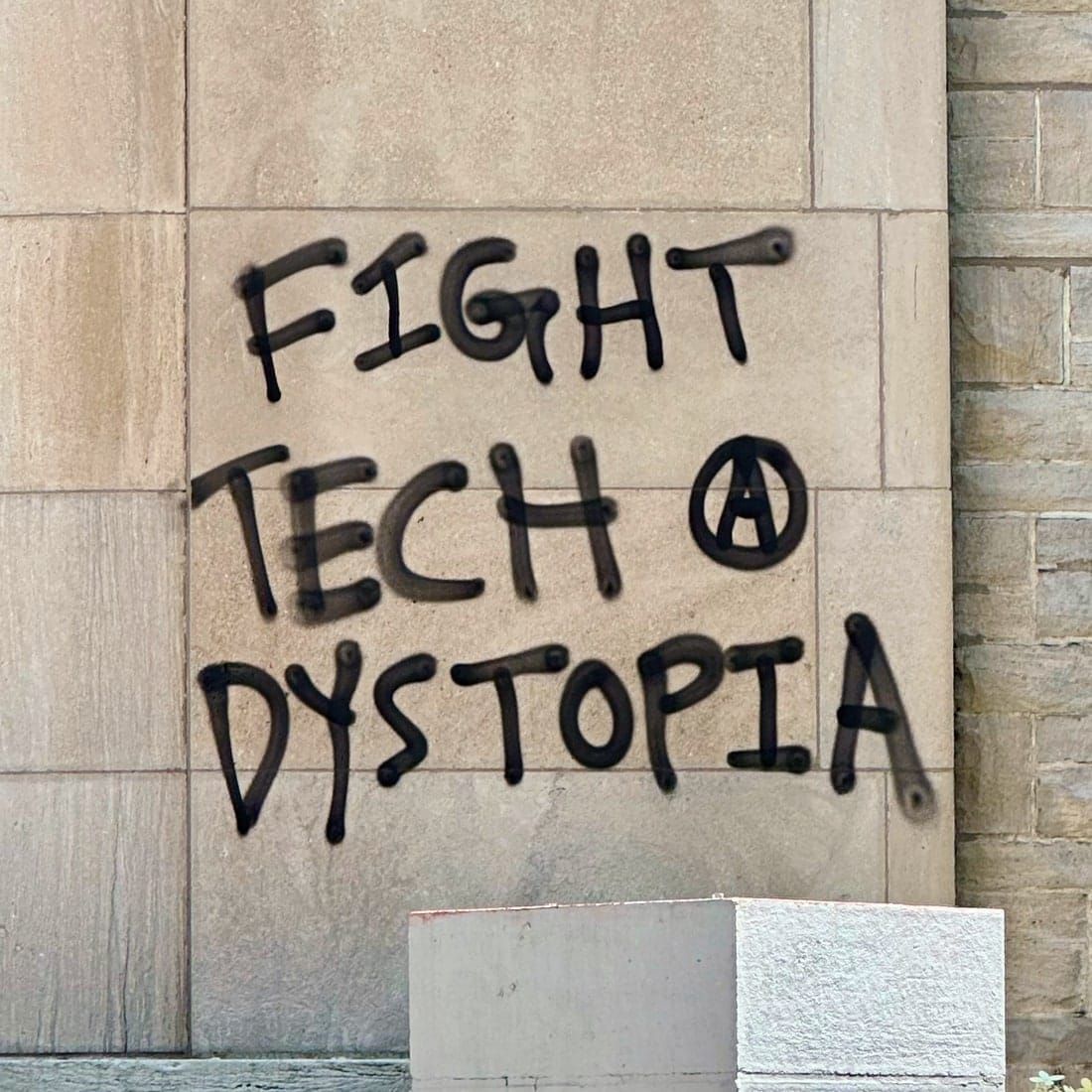
Now that heatwave season has ended (right??) in the northern hemisphere, time to get back to some newslettering. Thanks to the few people who reached out saying they missed their Sunday morning fix, that was great to read.
I don’t currently have a work/consultancy/client page on the Sentiers website and the description and “work shapes” listed on my personal page are woefully out of date—although they still give a pretty good sampling. You probably already guessed that I’m mentioning this because, like many an indie consultant, I have availability for client work!!
Foresight research; “observation research” (look on the about page for more, although I do need to write that up in more detail); writing of briefings, reports, monthly readings, etc.; “applied foresight,” a term I use for signals and trends research within innovation teams, for prototyping instead of reports. Basically, if you have questions about anything you’ve read about in the newsletter and want to dig deeper, I can provide some answers and do some of the digging for you. Hit me up at patrick@sentiers.media.
Last bit of (pre)promo: a couple of people have asked me for mentoring in the use of AI in knowledge work. I’m thinking of setting that up, it would look something like four calls, one every two weeks or month. On the first call I give you some details about how I work and potentially a few tools (Claude skills, documents, etc.), then we proceed by socratic dialogue (ok, I just mean Q&A ;-)), and perhaps a little homework/mini-mission to look into before your next call. If that sounds like something you might need, the address is above to show interest and offer feedback. If I go ahead, there should be more details coming over the next fortnight or so. It could also look like a group call at the same kind of frequency, but I’m unsure what the pricing of that might look like. Feedback welcome.
Neuroplasticity as a praxis
Matt Seybold expands on a reading list proposed by Tressie McMillan Cottom in a recent New York Times piece (see below this article’s quotes): a set of books, mostly by journalists and public scholars, addressing how technology, politics, and money are reshaping the present. Seybold’s own list, shared months earlier on Bluesky, first inspired Cottom’s, a conversation, like in the good old days of blogging… but not on blogs. His interest, though, is less in which books make the cut than in what she proposes doing with them. Reading these works closely, he argues, is not preparation for action but a form of action itself—a way of exposing that the difficulty of reading deeply, listening carefully, and talking about the present has been manufactured rather than inherited. He traces this argument back through Nicholas Carr and Maryanne Wolf, whose research on neuroplasticity showed that reading circuits in the brain are built, not given, and therefore fragile. Where Carr and Wolf worried in the 2010s about digital media reshaping cognition, Seybold believes that they underestimated how deliberately that reshaping would later be pursued: tech companies built products to be addictive, monetised that addiction, and enclosed the information people needed inside those same harmful products.
Seybold also writes about what he calls deliberate “deliteracy,” the restriction and monopolisation of the conditions that make mass literacy possible, wielded as a strategy for consolidating power. Wolf’s claim that reading circuits require collective, institutional maintenance becomes, in his reading, a democratic requirement under direct attack. His conclusion, correctly in my opinion, goes beyond private reading habits and towards organising: neuroplasticity only becomes a counterbalancing force if it scales into book clubs, discussion groups, and lending circles, rather than simply being seen as an individual practice. (Also check out the combined long list at the bottom, offered as raw material for that kind of organising, rather than a fixed canon.)
At one time in history these might have been relatively standard practices for readers of the New York Times. But these days I see little evidence that deep reading, careful listening, and critical conversation about our present epoch regularly take place. There is no reason it must be that way. But one thing that will happen if you do what Cottom prescribes is that you’ll figure out that it did not become that way by accident. […]
It is a type of direct action because one of the things which will become apparent as you read the books Cottom is recommending is that powerful forces are aligned against the practices of reading books, listening to researchers, and discussing why this period in our history is the way it is (and why maybe the next one doesn’t have to be). Deep reading, careful listening, and constructive conversing are harder to do than they used to be. […]
Unlike speech, is not a foregone conclusion that mass literacy will endure from generation to generation. And we may be shocked by what cognitive and affective capacities disappear if human communities stop doing the hard work of building reading circuits within their members.
§ I picked Seybold’s piece because of the neuroplasticity angle, but Cottom’s is also worth a read. She frames the same urgency in more explicitly political terms. She argues that AI isn’t a product but a political theory, and needs a vocabulary of its own: data politics. “All of the speculation and hype around A.I. is hiding the fact that the technology isn’t just large language models or agents or data centers. It is the backbone of a superstructure that merges regressive politics with unchecked economic power in the guise of technological innovation. Put simply, there is too much money, some of it too untraceable, giving a small group of unelected people too much power over the people. That’s data politics.”
The Ambiguist (or, what comes after science fiction?)
Karl Schroeder proposes a concept he calls abeyance: a conscious refusal to decide what a new technology is before its consequences are understood. He frames technology as legislation—each new tool changes the terms people live under before anyone has voted on it—and argues that we default to premature closure, forcing new phenomena into old vocabulary because uncertainty is uncomfortable. Social media, drones, and AI are all cases of the same mistake: names chosen too fast, that we are, to an extent, stuck with. To hold that space open, Schroeder invents a role, the ambiguist, whose job is to resist categorisation rather than produce it—a deliberate counterweight to large language models, which he notes are built to minimise perplexity rather than protect it. He combines this with a speculative institutional counterpart, a Department of Abeyance, tasked with auditing new policy for “Procrustean” label-fitting and with coining, and later retiring, terms such as thalience and deodand that hold a question open instead of answering it.
Where the piece feels shakier is the illusion that abeyance is still available once a technology has actually shipped. Schroeder’s clearest example, restricting social media to adults while researchers studied its effects on teenagers before wider rollout, arrives too late to matter: the platforms, their ad models, and their feedback loops were built and normalised during the years the label “social media” went uncontested. A word retired after the fact doesn’t unwind the habits and business models that formed under it. The same problem applies to “AI” today—a Department of Abeyance might vote to stop calling large language models intelligent, but the products, contracts, and expectations already built on that label aren’t waiting for a more precise one. Abeyance reads less like a policy lever than a discipline for individual thinkers, useful for slowing one’s own judgement, but not obviously exportable to institutions competing to ship first and define terms later.
Abeyance is the conscious refusal to decide that you understand something too soon. This is hard to do, because at the very least, we are expected to have an opinion on everything; for many of us, our jobs require us to be able to authoritatively state what we know, and deploy that knowledge. […]
The ambiguist has to exist as a specific kind of person, who draws a visible line in the sand declaring that we will not prematurely decide what some things are. Neither will we cede this closure of our worldview to AIs that someday will learn to reason but will be all the more dangerous because they’ll have been designed to always provide answers, never to shrug. The ambiguist legitimizes the shrug. […]
A genuine generalist, interested in everything and knowledgeable enough to be comfortable with trends analysis, modern physics, sociology and anthropology. […]
Wouldn’t it have been better to start by restricting it to adults, to see how it actually affects people, and study its impact on the adolescent mind before putting it in the hands of every confused teenager on the planet? We didn’t do that because the label—’social media’—tricked us as effectively as the companies pushing these products. We decided too soon that we knew what we were dealing with, and we’ve paid the price.
Side note → In a kind of parallel idea, here in Québec we try to have French translations of English terms. Sometimes it’s fast and easy like Intelligence Artificielle instead of Artificial Intelligence. But sometimes the Office québécois de la langue française (Quebec Office for the French Language) comes up with a translation that faces a steep hill, kind of like the one a Department of Abeyance might face. Will the other term catch on, or just be used by a minority?
Examples for francophiles and francophones from outside the province, a couple of terms that caught on: courriel for email, pourriel for sp@m. This line of thought brought in part by the newly announced answer to slop; contenu dégénératif (degenerative content). Which I kind of love, but has a long road ahead to replace the much shorter English word.
§ “The free school is the promoter of that intelligence which is to preserve us as a free nation. If we are to have another contest in the near future of our national existence, I predict that the dividing line will not be Mason and Dixon’s, but between patriotism and intelligence on the one side, and superstition, ambition, and ignorance on the other.”
—Ulysses S. Grant, in 1875
“Ambitious, thoughtful, constructive, and dissimilar to most others.
I get a lot of value from Sentiers.”
If this resonates, please consider becoming a supporting member—it keeps this work independent.
Futures, Fictions & Fabulations
- Science fiction and technology assessment: Fiction, speculation, and the future of emerging technologies. A full magazine issue, lots of great topics. “This is where speculative fiction re-enters TF and TA, not as entertainment or unaccountable advocacy, but as disciplined imagination. When paired with public participation, fiction can help translate forecasts into more plausible futures and explore possibilities that models cannot enumerate.”
- The science of foresight: how to future-proof your research. “Here, we call for futures methods to be plugged into the core mechanisms of scientific development, to inform decisions about what science should fund, build, teach, validate and evaluate. We call this concept translational foresight. Adopting it would make the promises embedded in research programmes explicit, testable, traceable and revisable.”
- Designs on the future. “Gem Barton: For me, it is not ‘the future’ as a concept that has become too restrictive, but rather that design has limited ways of engaging with the future. I am particularly interested in the role of design in/of futurity: the conditions that determine what can be imagined, whose futures become legitimate, and what design is able to rehearse in the present. I believe this is where they have the potential to become radically expansive again.”
Algorithms, Automations & Augmentations
- Librarians are hosting viral “Avoiding AI” workshops for people who are fed up with Big Tech. “As a librarian, I think it’s important to see this as advancing digital literacy and helping people reclaim their autonomy over whether they want to use AI tools. It’s important, especially when it can be so difficult not to use them, and when the design seems to force adoption.”
- AI companies are trying to hide a staggering amount of debt. “As Japanese financial newspaper Nikkei Asia found in a recent investigation, just five US tech giants — Alphabet, Microsoft, Amazon, Meta, and Oracle — are hiding an estimated $1.65 trillion in debt that doesn’t appear on balance sheets. That’s even more than the $1.35 trillion in debt the five companies officially reported in their financial data for the most recent quarter.”
- This AI just created viruses not found in nature. “Scientists trained artificial intelligence on libraries of DNA and then asked the model to create recipes for viral genomes. Sixteen of them were viable, yielding new viruses.”
- Beijing is forcing a mass breakup with AI lovers. “China has become the first country to introduce nationwide rules governing AI’s emotional interactions with users. The move reflects Beijing’s increasingly proactive approach to AI governance, as governments around the world still grapple to address the societal risks posed by increasingly sophisticated AI.”
Built, Biosphere & Breakthroughs
- What if we never built another new building?. “Instead of asking what should be built, Barbara Buser asks what can be saved.”
- World’s tallest timber tower tops out in Sydney. “Designed as the Sydney headquarters for technology company Atlassian, the 180-metre-high office tower topped out earlier this week. With a hybrid structure of timber, steel and concrete it overtakes the 86.6 -metre-high Ascent tower in Milwaukee, USA, by almost 100 metres, to become the world’s tallest hybrid timber tower.”
- Indigenous fiber network connects remote subarctic towns. “WJBTN is part of a broader movement among Indigenous and remote communities seeking more control over their telecommunications infrastructure. In the United States, 30 tribes now operate fiber-to-the-home networks, many launched during COVID. Canada has since created a dedicated Indigenous broadband funding stream.”
Asides
- Seoul’s outdoor library attracts a million visitors in just 90 days. “But it’s more than just piles of books out in the open. The Seoul Outdoor library consists of curated collections (over 12,000 new books added in 2025), comfy seating (beanbags, etc.), ambient lighting, furniture design, and zones for different moods (reading, relaxation, performances, etc.).” (2025)
- Reading Maps. “Journeys from books & films (Moby-Dick, Murder on the Orient Express, The Hunt for Red October, The Muppet Movie, etc.) plotted on a map.”
- The phone in your hand. “Your phone is the most intricate machine you’ve ever held. Let’s take it apart.”