
Scenario planning for the “jobless future” ⊗ Software brains & statistical engines
No.400 — Extrapolated futures archive ⊗ The dissonance is expanding ⊗ South Korea to spur a renewables revolution ⊗ Eye contact with a humpback whale
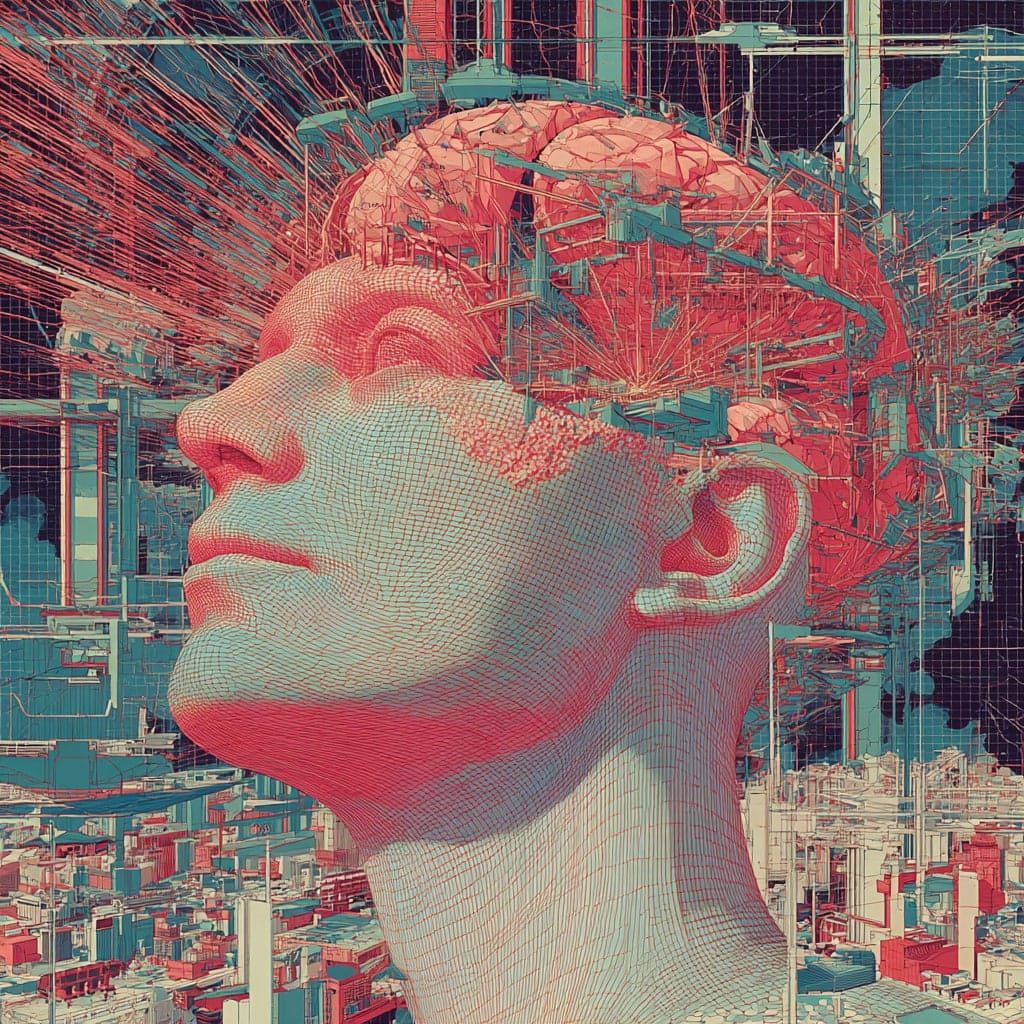
Scenario planning for the “Jobless Future”
It’s the second time I share a piece by Tim O’Reilly where he applies scenario planning to AI—last time was back in issue No.384. I like this “series,” on this one he’s looking at some of the signals around employment, and comes up with useful quadrants. As we do in foresight, he maps divergent possibilities rather than predicting a single outcome; his goal her is to find robust strategies that hold across all quadrants. He plots two vectors: the scale and pace of AI’s economic impact (capability combined with adoption speed), and whether that impact flows toward efficiency (doing the same with fewer people) or toward doing more, serving previously unmet needs.
The lower two quadrants differ mainly in speed: the Slow Squeeze erodes entry-level work quietly, while the Displacement Crisis delivers unemployment topping 10%. The upper-left Augmentation Economy sees AI widening individual workers’ capacity. The upper-right Great Transformation is the scenario worth dwelling on: rapid AI adoption directed toward new applications—drug discovery, personalised education, care at scale. O’Reilly draws on economist Alex Imas and Noah Smith to argue this quadrant isn’t merely a moral preference; it’s where the stronger businesses end up. Three-quarters of AI’s economic gains, per a PwC study he cites, are flowing to the 20% of companies focused on growth rather than cost-cutting.
Post-creation of the scenarios, O’Reilly calls signals “news from the future,” data points that gradually reveal which quadrant the world is entering, and the ones he shares are quite mixed. The robust strategy that holds across all four is the same: orient toward doing more rather than toward efficiency. Every time AI is used to do the same work with fewer people, it’s a vote for the lower half of the grid; using it to do something previously impossible, to serve previously unmet needs, pushes toward the upper half. As long as there is this kind of demand and unsolved problems, he argues, AI augments rather than replaces; it’s only when we stop looking for new things to do that the machines come for the jobs.
They model jobs as bundles of tasks, and distinguish between “strongly bundled” jobs (where the same person has to do multiple interdependent tasks) and “weakly bundled” ones (where tasks can easily be split between a human and an AI). AI replaces the weakly bundled jobs first. But even for weakly bundled jobs, automation only replaces human labor after demand becomes inelastic, after AI is so productive at the task that making more of the output hits diminishing returns. […]
In the upper quadrants, all three categories thrive. Specialists do well because AI expands the scope of what their bundled expertise can accomplish. Salarymen thrive because companies that are doing more, not just doing the same with less, need people who can adapt to constantly changing tool capabilities within the context of their business. And small businesses proliferate because AI gives a one-person shop the productive capacity that used to require a department. […]
Create professional associations that lean into mentorship and an AI-enriched career ladder, but aren’t afraid to take a political stance. The idea that providers of capital are entitled to all of the gains is a pernicious idea that has created an engine of inequality rather than of wide prosperity. It doesn’t have to be that way. Professional associations and other forms of solidarity are a possible source of countervailing power.
Software brains & statistical engines
Nilay Patel coins “software brain”, the cognitive habit of seeing the world as a series of databases controllable through structured language. In Sentiers “lingo,” I’d refer to this as a lens, here Patel means the way some people in tech perceive the world around them, and the opportunities they see. I find the concept very useful: it’s in line with Marc Andreessen’s 2011 declaration that “software is eating the world,” which is still quoted regularly (even broligarchs are correct sometimes). In this view, if you can model something as a database, you can manipulate it, optimise it, scale it. Uber is a database of cars and riders; YouTube is a database of videos; DOGE arrived in government and immediately tried to govern by controlling databases. The legal system’s formal language (statutes, precedents, case citations) is seductively similar to code, which is why tech people and lawyers share an intoxicating mutual recognition; both believe the other has found a way to issue commands to reality.
I’m almost done watching a fantastic interview with Karen Hao on The Diary of a CEO podcast, and what she describes about Ilya Sutskever’s and Geoffrey Hinton’s conviction that human brains are “statistical engines” (a hypothesis, she’s careful to note, not established science) connected immediately for me with what Patel is describing. Both rest on the same equation of mind with machine, approached from two directions: one looks at brains and sees computers; the other looks at the world and sees data it can process with code. In a way, squinting a bit, the researchers trying to build AGI while relying on the statistical engine hypothesis are applying “software brain” to biology. Patel’s observation is that everyone downstream from that hypothesis has been applying the same cognitive style outward, to society at large. They see data that can be computed.
To connect to a number of other pieces shared in the past, I’d also mention that Patel basically proposes a version of Alfred Korzybski’s “the map is not the territory,” that “the word is not the thing.” The database is always a simplification of the territory it models, and at some point every database stops matching reality. His insight was that we routinely confuse our representations of things with the things themselves and act on the map as though it were the world. Software brain takes this confusion as its operating premise: when the map and the territory diverge, the response is to change the territory, not the map. Asking people to make themselves legible to AI is that inversion turned into a business model.
Quinnipiac just found that over half of Americans think AI will do more harm than good, while more than 80 percent of people were either very concerned or somewhat concerned about the technology. Only 35 percent of people were excited about it. […]
Any business process that looks like code talking to a database in a repetitive way is up for grabs. That’s why Anthropic has been so relentlessly focused on enterprise customers, and it’s why OpenAI is now pivoting to business use. There’s real value in introducing AI to business, because so much of modern business is already software: collecting data, analyzing it, and taking action on it over and over again in a loop. Businesses also control their data, and they can demand that all their databases work together. […]
But: not everything is a business. Not everything is a loop! The entire human experience cannot be captured in a database. That’s the limit of software brain. That’s why people hate AI. It flattens them. […]
Even taking the time to consider how much of your life is captured in databases makes people unhappy. No one wants to be surveilled constantly, and especially not in a way that makes tech companies even more powerful. But getting everything in a database so software can see it is a preoccupation of the AI industry.
“Ambitious, thoughtful, constructive, and dissimilar to most others.
I get a lot of value from Sentiers.”
If this resonates, please consider becoming a supporting member—it keeps this work independent.
Futures, Fictions & Fabulations
- Extrapolated futures archive. “The Extrapolated Futures Archive is a reverse-lookup for speculative fiction. Describe a situation you are facing, and find the SF stories that already worked through the implications. The catalog connects stories (novels, novellas, short stories, films) to the speculative ideas they explore: thought experiments about technology, governance, biology, society, and more. Every idea is tagged with domains, scenario types, and outcome types so you can filter by the kind of future you are thinking about.”
- Beyond Tomorrow: Four Scenarios for the World of 2050. “Explore four distinct visions for 2050—representative of the range of plausible futures and based on detailed quantitative analysis of 100 megatrends and a century of historical data. The journey to 2050 could take several routes. By developing a strategy that accounts for multiple possible futures, leaders can safeguard long-term competitiveness while understanding how best to position their organizations today.”
- Transforming with STILE: a practical method for making decisions with the future in mind. “… this is where the STILE framework comes in—a strategic tool designed to assess the feasibility and readiness of emerging ideas across five critical dimensions called STILE Elements: Social Acceptance, Technological Capability, Infrastructure, Legal Clearance, and Entrepreneurial Zeal.”
Algorithms, Automations & Augmentations
- The dissonance is expanding. You should read Kai’s intro to his latest issue, well put! “I find it increasingly hard to be part of an industry that is building a future I fear is becoming deeply anti-human. The person with seventeen browser tabs and a Claude Code subscription and the person who considers human creativity and the arts indispensable – they both feel like me. I’m just not sure they can fully coexist anymore. The tension is real.”
- Open-world evaluations for measuring frontier AI capabilities. “AI models have started to saturate most major benchmarks. But does that mean they can build and ship a real product, or conduct a scientific experiment end-to-end, or navigate a government bureaucracy? Researchers have started testing AI in such real-world settings. We call these evals ‘open-world evaluations’. This essay defines open-world evaluations, surveys the lessons learned so far, and lays out best practices for conducting them.”
- The AI Roadmap: How We Ensure AI Serves Humanity. “In our new report, we offer seven principles that outline how the technology should be built, deployed, and governed. They’re a roadmap and an invitation. Together, we can take the first steps toward that better future.”
Built, Biosphere & Breakthroughs
- How South Korea plans to use the Iran crisis to spur a renewables revolution. “In Guyang-ri, a farming village of 70 households about 90 minutes south-east of Seoul, people gather for communal free lunches six days a week. The meals are funded by the village’s one-megawatt solar installation, which generates roughly 10m won ($6,800) in net profit each month.”
- The disappearance of the public bench. “Benches are microcosms of an expansive debate about who belongs in urban public spaces. When they are removed or made uninviting, we lose more than just a place to rest.”
- The US offshore wind industry finally gets a break. “Burgum had vowed to fight back, but last week, the department quietly let the final deadline for appealing the courts’ decisions lapse. The move means construction of the nation’s first five major wind farms along the eastern seaboard can continue absent a change in the case. When complete, the wind farms will generate enough electricity to power well over 2 million homes.”
Asides
- Eye contact with a humpback whale. “This moment of eye contact was beyond my wildest dreams. I’ve never encountered a whale like this one, and it was the most profoundly beautiful experience of my life.”
- This Filipino man transformed his home into a free library for all. Respect! “What makes Reading Club 2000 so special isn’t just that it has books; there are many libraries, after all, but that it truly belongs to everyone. At Mang Nanie’s library, there’s: No membership card. No library card. No borrowing limits. No fees or fines. You can walk in, take a stack of books with you, and never be asked to return them. You can even keep them.”
- “Is it life? We can’t tell”: Nasa’s Curiosity rover finds organic molecules on Mars “including chemicals widely considered building blocks for the origin of life on Earth. Five of the seven molecules identified in a dried lakebed near the equator had never previously been observed on the red planet.”