
Towards kindred futures ⊗ What more-than-human really means
No.417 — The map fiction missed ⊗ Cognitive integrity ⊗ The massive layer of life just beneath our feet ⊗ NASA’s Nancy Grace Roman Space Telescope
Towards kindred futures
Ana Sun, writing in Vector, asks why everyday speech treats “the future” as singular when—as we’ve covered here abundantly—many are possible, and whether that habit makes climate collapse feel like destiny. Science fiction was meant to widen the view. Ursula K. Le Guin held that “science fiction is not predictive; it is descriptive,” and Istvan Csicsery-Ronay calls it “imaginary prediction,” a way to explore and question forecasts. Sun argues that its cautionary tales have instead become “ingrained blueprints” for the powerful, and that the genre now needs to serve as a tool for deliberate imagination.
Sun also looks at why distant futures are hard to picture at all, and the answer lies partly in how memory works. Daniel Kahneman’s “remembering self” is “a storyteller” that discards lived moments and keeps a narrative, and Martin Conway and Catherine Loveday find that remembering the past and imagining the future rely on the same system. Both blur with distance, like a “fish-eye lens,” so a distant goal such as a stable climate lacks the cues of a doughnut in a shop window. I’m just skimming over this to focus on the angle below, but it’s a great section of the piece that you should also look into.
What I hadn’t heard of before, and found the most important to share, is the six orientations Rebecca Bryant and Daniel M. Knight propose in The Anthropology of the Future. Destiny is a future that arrives regardless of what happens in between—the stance Sun suspects many have adopted toward climate breakdown and an inequitable AI future. Expectation leans on past experience, like taking an umbrella “just in case” because forecasts have been wrong before; it grounds the present in what has already happened. Anticipation “slims the present” and draws the future into current activity, like smelling rain and closing the windows. Speculation sits in the gap between the two, when information is partial; the UK’s bet on a mix of nuclear, geothermal, solar and wind is her example. Potentiality is rooted in things already set in motion, such as the solar farms she counts on a train to North Wales. Bryant and Knight place hope “in the gap between the potential and the actual,” though Sun prefers Rebecca Solnit’s version: “hope is an ax you break down doors with in an emergency.”
Sun argues that hope has to be collective to matter, and points to Rob Hopkins’s “collective mental time travel”: groups assemble visions of the future out of shared memories, so creating those memories on purpose gives a community more material to imagine with. In her account, this is how people “reclaim our agency from the illusion of destiny” and move toward what she calls “kindred futures.”
It would be interesting to see how the six orientations could be combined with the Voros futures cone. Perhaps the cone to locate a future by how plausible or likely it seems, and the orientations to describe how people hold that future and act on it in the present?
Have we inadvertently accepted a destiny described by cyberpunk, a future rocket-boosted by uncaring technology, systems of oppression and power concentrated in the hands of a few? In Zoefuturistic terms, have we simply accepted the ‘being’ and forfeited the ‘becoming’? […]
Consider the supposedly more progressive works of authors like Simak, Asimov, Pohl Anderson, Blish, or Roddenberry. Most, if not all, of their ideas and values are realized through individualist, liberal lenses. They are mostly concerned with heroes who uphold values such as compassion, honor, duty, and virtue. They very rarely, if ever, engage with meaningful, systematic criticisms of society. […]
The idea of the supremacy of science, without engaging in its colonial roots, without engaging with ideas and problems like eugenics, without any meaningful critiques of its role in serving capitalism, is one of the main motivating powers of much of the careers cited above. […]
Hope is not like a lottery ticket you can sit on the sofa and clutch, feeling lucky. I say it because hope is an ax you break down doors with in an emergency; because hope should shove you out the door, because it will take everything you have to steer the future away from endless war, from the annihilation of the earth’s treasures and the grinding down of the poor and marginal. Hope just means another world might be possible, not promised, not guaranteed. Hope calls for action; action is impossible without hope.
What more-than-human really means
It might be my own failing more than their writing, or perhaps a mix of both, but I find some similarity between this Paul Graham Raven article and Wark’s Lifted AF piece last week. Not in topic, but in the setting up of references and the academic-adjacent writing. You need to kind of slowly submerge yourself in there, picking up the threads (sorry for the mixed metaphor), before really getting into the argument, but it’s worth the plunge.
Raven’s concern is how “more than human” has been worn down in circulation. In general use it has become mostly a synonym for adding plants and animals to places where you wouldn’t expect them, a habit he sums up with a property prospectus featuring “a beehive on an apartment-block balcony.” His point is that Haraway’s concept is about dependency, and about following the connections further than is comfortable. The bees themselves provide an example: in 2010, Brooklyn beekeepers found their honey had turned bright red because the bees were feeding on syrup at a nearby maraschino cherry factory. Trace those bees back into the food industry and you get the kind of more-than-human stories “we’d be much happier for not knowing, but all the wiser for having heard.”
Beneath this sits the split between humans and “nature,” an assumption no one is taught directly but which underpins religion, science, law, and economics. It treats the sources of raw materials and the sinks for waste as “off the books,” and so hides both our complicity and our dependency. Haraway’s response is “response-ability”: the capacity to answer to the creatures and systems we are bound up with, which begins with acknowledging those ties. The aim is recognition of complicity “in a tangled world where no one’s hands are clean”; shame has little to do with it.
Staying with the trouble, in Raven’s reading, means refusing the promise of the solution, which seals the web of connection “in a neat black box, never to be opened.” Hormone drugs made from pregnant mares’ urine were a solution; fossil fuels still are for some, and fusion and green hydrogen are sold the same way. What they all offer is relief from thinking about where things come from and where they go once we’re done with them. “We cannot ‘innovate’ our way out of the accumulated and compounded consequences of decades, if not centuries, of ‘innovation’.” The way out is through: tracing our entanglements so they can become less exploitative, one supply chain at a time.
The primacy of the Cartesian split between the knower and the known in early modern philosophy—that we humans are in some essential way separate from and entitled to “nature”, another name for the world (or indeed the universe) conceived as a passive (and female-coded) body which we are encouraged—nay, intended—to exploit. […]
The ability to respond to the creatures and systems with which you are in a relation of kinship must start—but should not end—with your seeing and affirming that kinship, with you acknowledging your place (and theirs!) in the web of mutual dependency which is existence. […]
The one single problem that all these and many more solutions all seek to solve is the impinging awareness of our connectedness to the world, which must eventually force us to confront the ruinous way in which we have despoiled it, and in so doing despoiled ourselves. […]
If there is a way out, then the way out is through: by coming to terms with our entanglements, and learning to trace them, we might slowly come to learn how to make them less exploitative, and our more-than-human flourishings more mutual.
If you’d like to support the newsletter, please share it with a friend or colleague who you think might enjoy it. I appreciate the help!
Futures, Fictions & Fabulations
- WEF Critical Questions for Leaders 2026. (Direct link to a PDF.) “The discussions pointed to a common conclusion: foresight is most valuable when it becomes a practical tool to facilitate decision-making. It helps leaders test assumptions, interpret signals, map cascading consequences, understand systems, preserve human judgement and act before certainty is available.”
- Deftech Scan, August 2026 edition. “Across the defence and national-security landscape, longstanding boundaries, assumptions, and operating models are steadily wearing away. The lines between peace and conflict, military and civilian targets, domestic and foreign technology, human and machine decision-making, industrial paradigms, and the battlefield and the broader economic and social systems that sustain national power have been blurred.”
- The map fiction missed. (A short article by yours truly.) “Canada and the European Union are discussing an associate membership for Canada, a scenario I can’t recall seeing in science fiction or alternate history. Speculative maps of North America have usually split Canada into successor states or handed its pieces to rival blocs.”
Algorithms, Automations & Augmentations
- Cognitive integrity. “Concern about AI and mental health has concentrated on children, yet the vulnerabilities in question apply to everyone. This project introduces cognitive integrity - the capacity to think and decide on your own terms rather than on engineered influence – and asks whether Europe’s rules protect it.”
- Paying for frontier AI models buys 4-month head start at 5x the cost. “Most organizations should ideally be using open models as the default for the majority of their work … The report highlights how a leading open model, Moonshot AI’s Kimi K3, achieves a composite AI performance score on the Artificial Analysis Intelligence Index that is just three points behind Anthropic’s Fable 5 closed frontier model, all while costing just 30 percent of the latter.”
- China’s white-collar experts are training AI to pay the bills. “Squeezed by a stagnant economy and state directives, China’s underemployed lawyers, architects, and engineers are taking cheap gig work to teach AI their exact trades — just to pay this month’s mortgage.”
Built, Biosphere & Breakthroughs
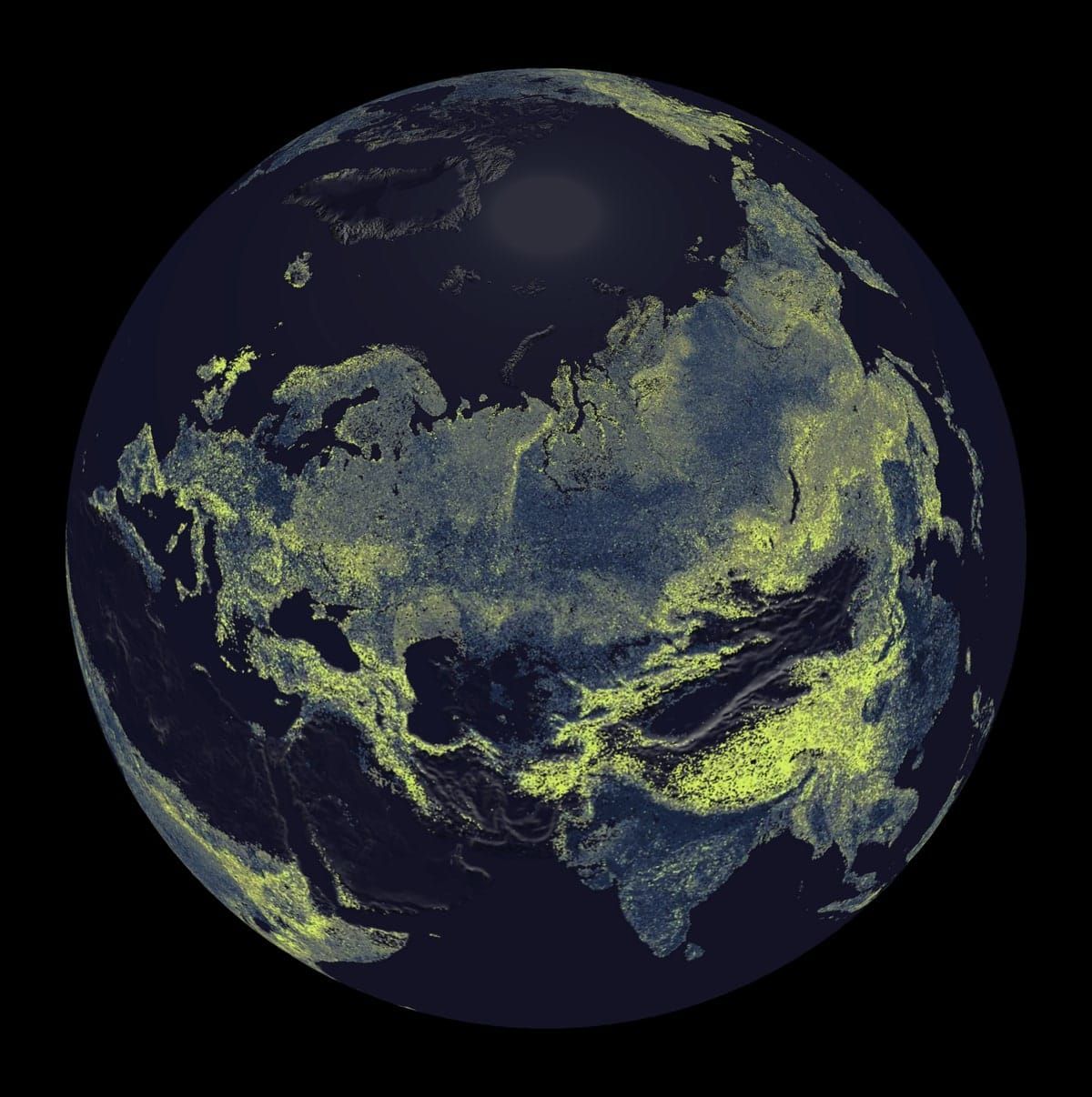
- Scientists map massive layer of life just beneath our feet. “Another way of gauging the network’s size is to consider its weight instead of its length. In total, it is estimated to weigh around 300 million tons, which, the authors write, is roughly five times the biomass of all humans on Earth combined.”
- The tipping points playbook: The Earthshot Prize and the University of Exeter reveal how to make environmental repair unstoppable. “New research identifies over 50 solution areas with the potential to trigger rapid positive, self-propelling planetary repair by 2030. Solutions such as commodity supply chain transformation, clean household energy and marine protected areas could all have an outsize effect in repairing our planet.”
- The surprising reason California survived record summer heat without blackouts. “Californians just made it through the hottest August on record without having to endure any rolling power outages. … Over the last few years, California has quietly but dramatically increased the resiliency of its electrical grid through a significant expansion in battery energy storage. … These batteries hold onto solar energy captured during the day, so it can be sent to the grid as demand peaks in the evening and morning, when most people are at home running air conditioners and other appliances.”
Asides
- NASA activates Roman’s primary instrument, checks out Coronagraph. “…the Wide Field Instrument, a 300-megapixel infrared camera that will allow scientists to explore wide swaths of the cosmos very quickly without sacrificing exquisite detail. Roman’s planet imager also stretched its digital, electronic, and mechanical “limbs” as part of an initial test after waking up earlier this month.”
- Max Verstappen vs. 100 normies in go-karts. “Red Bull took over one of the karting tracks at Silverstone (home of the British Grand Prix), put 100 regular folks in karts, positioned four-time F1 champ Max Verstappen at the back of the pack, and gave him 75 minutes (or 30 laps) to pass everyone. Spoiler alert: he only needed 35 minutes”
- Caribbean scientists document uncharted deep-sea waters in Trinidad and Tobago. “The Caribbean-led team mapped 11,335 square kilometers (approximately 4,376 square miles) of previously uncharted seafloor — an area about two-and-a-half times as big as Grand Canyon National Park in the U.S. The expedition team also collected more than 700 specimens, including many Amon said she believes will be identified as new species.”
“Ambitious, thoughtful, constructive, and dissimilar to most others.
I get a lot of value from Sentiers.”
If this resonates, please consider becoming a supporting member—it keeps this work independent.